Quick answer: When is lumber ready to build with?
Lumber is a reasonable candidate for assembly when correctly taken moisture readings are compatible with its intended indoor conditions, repeated checks show no clear continuing trend, and unexplained wet areas have been investigated. Check several locations and boards—not just one convenient spot. Store the lumber with airflow in conditions similar to where the finished piece will live. There is no moisture percentage or acclimation period that suits every project. This decision rule follows the Forest Products Laboratory’s guidance on moisture equilibrium, measurement, and storage. (research.fs.usda.gov)
1. Understand what a wood moisture reading means
Moisture content, or MC, expresses the mass of water in wood as a percentage of the wood’s oven-dry mass. It is not the percentage of a board’s volume occupied by water, and it is not the same as the room’s relative humidity. An electronic meter estimates MC from electrical properties rather than weighing the water directly. (research.fs.usda.gov)
Wood exchanges moisture with the surrounding air. Given sufficiently steady conditions and enough time, it approaches equilibrium moisture content, or EMC: the moisture level associated with that environment’s temperature and relative humidity. Changing conditions change that equilibrium. (research.fs.usda.gov)
That distinction explains why “dry” lumber can still cause problems. A board suitable for storage in a humid garage may lose moisture after becoming furniture in a drier room. At typical furniture moisture levels, moisture loss causes shrinkage, while moisture gain causes swelling. Different drying rates within a board can also create stresses and defects. (research.fs.usda.gov)
Treat the meter as a decision tool, not a guarantee. It helps answer three questions:
- Does the lumber’s moisture level make sense for its destination?
- Are readings reasonably consistent across the material?
- Is the lumber still changing?
2. Match the target to the finished piece’s environment
Start with the destination, not a number printed on an internet checklist.
For an indoor shelf, organizer, or tabletop, record temperature and relative humidity where the piece will normally be used. Take observations under normal heating or air-conditioning conditions, rather than relying on one unusual afternoon.
The Wood Handbook’s Table 4–2 shows why a universal target is misleading. At approximately 70°F (21°C), it gives these equilibrium estimates:
| Room relative humidity | Approximate wood EMC |
|---|---|
| 30% | 6.2% |
| 40% | 7.7% |
| 50% | 9.2% |
| 60% | 11.0% |
These are reference estimates, not exact acceptance limits. The handbook explicitly warns that the table’s decimal precision does not represent meaningful real-world precision; wood specimens and moisture history introduce variation. (research.fs.usda.gov)
Use the table to establish a plausible moisture range for your circumstances. Do not chase a decimal place that your meter and environmental observations cannot justify.
Seasonal conditions matter too. Acclimating lumber reduces the initial mismatch between the wood and its destination; it does not prevent later moisture-related movement. Your assembly still needs a design that accommodates that movement. (research.fs.usda.gov)
If you do not know the destination’s conditions, say so in your project notes. “Heated indoor room, humidity unknown” is an uncertainty to resolve—not a reason to assume every board should reach 8%.
3. Use pin and pinless meters within their limits
Both types can help, but they do not sample wood in the same way.
Pin meters use electrodes driven into the wood and measure electrical resistance or conductance. They leave small holes. Uninsulated pins respond to the wettest material along their contact length; insulated-shank pins read at their exposed tips and can help investigate differences between the surface and interior. Short pins do not establish that a thick board’s core is dry. (research.fs.usda.gov)
Pinless meters use an electrical field through a surface sensor. They allow checks without pinholes, but thickness, sensor contact, and measurement depth matter. The Wood Handbook notes that surface layers strongly influence these readings, so a substantial moisture gradient can make a reading unrepresentative of the core. (research.fs.usda.gov)
Before measuring, check your exact manual for:
- Species settings or correction tables.
- Wood-temperature corrections.
- Permitted thickness and measurement depth.
- Sensor coverage or electrode orientation.
- Battery and calibration-check procedures.
For example, the Delmhorst J-4 manual specifies pins parallel to the grain, species corrections, and temperature corrections outside its stated temperature band. The Wagner Orion 930 manual specifies species and depth settings, full sensor coverage, firm contact, and at least a 1-inch (25 mm) air gap beneath the board. These are model-specific instructions, not universal rules. (delmhorst.com)
Also distinguish a moisture percentage from a relative scale. Both manuals describe relative readings for certain panel materials. A relative reading on plywood or MDF should not automatically be treated as solid-wood MC. (delmhorst.com)
4. Sample the boards, not just the easiest spot
A single reading cannot describe an entire stack. Even within one board, surface and interior moisture can differ. Ends also exchange moisture quickly, making an end-only check a poor basis for judging the rest of the material. (research.fs.usda.gov)
For a small hobby project, use this practical sampling routine:
- Identify each board. Use removable labels or pencil marks in waste areas.
- Record the setup. Note species, meter model, corrections, and measurement depth.
- Check several clear locations along each board. Include its middle and areas toward both ends, while respecting the meter’s required coverage.
- Check the opposite face where accessible.
- Record individual readings and their range. Do not retain only the average.
- Mark the locations for repeat checks.
This is a workshop routine, not a formal acceptance-sampling standard. Its purpose is to reveal variation and make later comparisons repeatable.
Choose locations and orientation permitted by your manual. The Orion 930 instructions, for instance, exclude noticeable knots and defects from measurements. (wagnermeters.com)
If one area reads unexpectedly high, repeat it with the setup checked. Compare nearby locations and the opposite face. A difference may indicate real moisture variation, but it can also reflect poor contact, an unsuitable measurement depth, or another measurement problem. Do not label a board “wet inside” from one unexplained number. (research.fs.usda.gov)
Use a simple log:
| Date | Board/location | Corrected MC | Depth or pin setup | Room temperature/RH |
|---|---|---|---|---|
5. Store lumber with airflow in suitable conditions
Acclimation means allowing moisture adjustment toward the intended environment. Simply putting boards indoors does not prove that adjustment is complete.
The Wood Handbook recommends humidity-controlled storage for lumber intended for furniture. It also states that stickered storage in appropriate conditions can bring stock toward the required moisture range; material needing a large moisture change may require redrying rather than ordinary storage. (research.fs.usda.gov)
For a small stack:
- Use a stable, supported base above the floor.
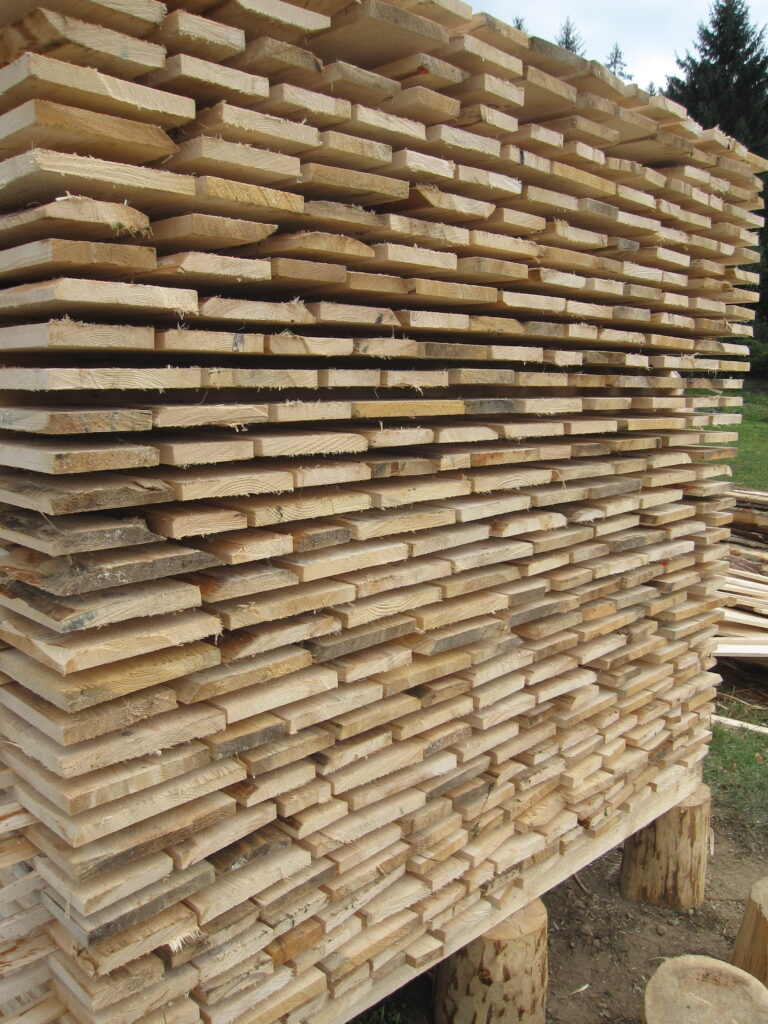
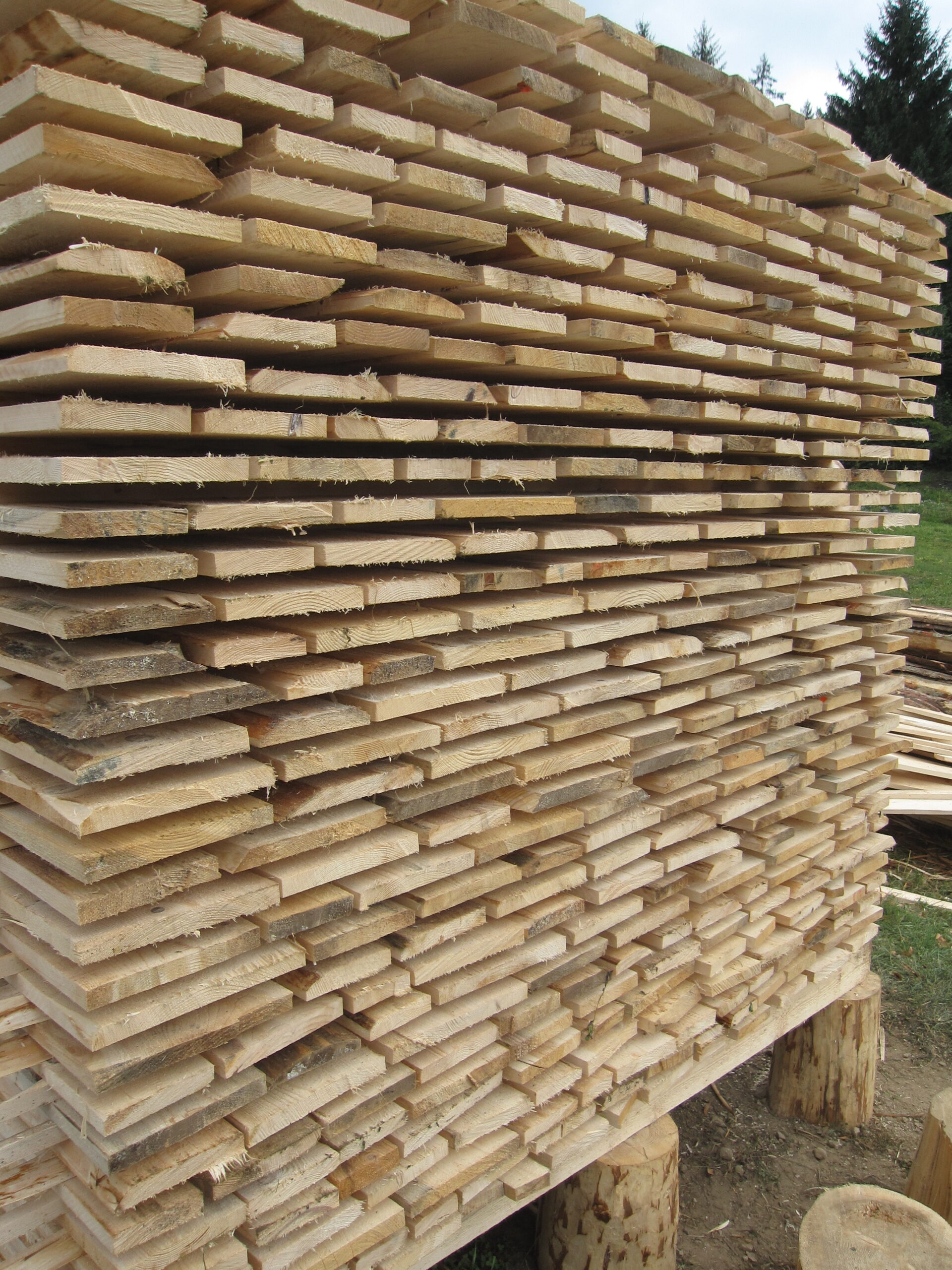
- Separate layers with stickers—spacer strips that leave air passages.
- Use consistent spacer thickness and align supports through the stack.
- Keep the arrangement stable and accessible for repeat measurements.
- Protect the lumber from liquid water.
- Monitor the storage area’s temperature and humidity.
These are practical adaptations of the handbook’s supported, stickered-storage guidance. Do not copy an industrial drying arrangement or schedule without considering your material and space. (research.fs.usda.gov)
Avoid trying to hurry the process with concentrated heat or severe drying conditions. The handbook describes how excessively rapid surface drying can create stresses and checking. A warm surface is not evidence of a dry core. (research.fs.usda.gov)
There is no dependable “one week indoors” rule. Moisture movement depends on the wood and its surroundings, including the moisture gradient, temperature, and humidity. Use repeated measurements to assess progress rather than a fixed calendar deadline. (research.fs.usda.gov)

6. Worked example: garage boards for an indoor shelf
Suppose you plan a shelf using boards stored in a garage. The finished shelf will live in a room measured at approximately 70°F and 40% relative humidity.
Table 4–2 places the reference EMC near 7.7% for those conditions. Use that as context, not an exact pass/fail threshold. (research.fs.usda.gov)
Now suppose your correctly configured meter shows the following hypothetical readings:
| Board A location | Initial MC |
|---|---|
| First clear location | 11% |
| Middle | 14% |
| Third clear location | 12% |
These numbers are illustrative, not test results or predictions.
The useful conclusion is not “the average is about 12%, so start cutting.” The board appears wetter than its destination’s equilibrium estimate, and its middle needs investigation.
Proceed in this order:
- Confirm the species correction and any temperature correction.
- Repeat the middle reading with the required contact, coverage, and support.
- Check nearby areas and the opposite face.
- If the higher reading persists, investigate depth limitations before assuming the core condition.
- Store the boards with airflow in suitable indoor conditions.
- Repeat the same locations and record the trend.
This approach follows the handbook’s guidance on meter limitations, moisture gradients, and conditioning stock in appropriate storage. (research.fs.usda.gov)
If later readings become compatible with the room and stop showing a clear trend, that supports proceeding. If readings remain high or keep declining, more adjustment or investigation is needed. Neither outcome tells you in advance how many days acclimation will take.
7. Make the final assembly check—and avoid common mistakes
Before final sizing and assembly, review four things:
- Environment: Does the storage climate reasonably represent the destination?
- Measurement: Were readings taken within the meter’s instructions?
- Trend: Are repeat checks no longer clearly increasing or decreasing?
- Variation: Have unusually high readings or face-to-face differences been explained?
This is a practical decision checklist derived from the handbook’s moisture and measurement guidance, not a certified acceptance test. (research.fs.usda.gov)
Avoid these common shortcuts:
Trusting “kiln-dried” as a current reading. Drying terminology does not establish today’s moisture content. Lumber can change during transport and storage. Measure the material you actually have. (research.fs.usda.gov)
Averaging away a wet area. An average conceals the distribution. Keep the highest readings and their locations visible in your log.
Mistaking stability for suitability. Steady readings in a humid garage can still be inappropriate for a drier indoor destination. Stability and environmental compatibility are separate checks. (research.fs.usda.gov)
Treating displayed decimals as certainty. Electrical measurement has uncertainty. Small fluctuations should be interpreted alongside the meter’s documented accuracy and your measurement consistency. (research.fs.usda.gov)
Assuming acclimation eliminates movement. Wood continues responding to humidity after assembly. Moisture readiness reduces one source of trouble; it does not replace movement-aware design. (research.fs.usda.gov)
The strongest basis for starting is a set of repeatable, plausible readings from representative locations, taken in known conditions—not one reassuring number.